
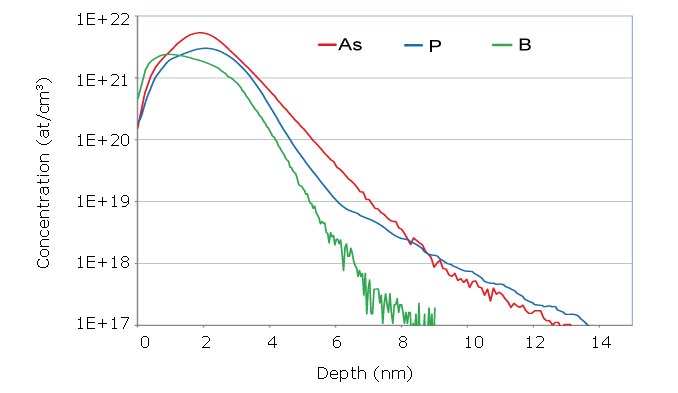
The production of the latest semiconductor chips and the continued miniaturization of CMOS components are pushing the limits of junction depth (junction depth) below 10nm, with profile steepness (profile steepness) reaching 1-2nm per decade (decade). At such scales, SIMS techniques can be used to monitor the depth distribution of dopants (dopants), demonstrating that SIMS profiles can be measured with depth resolution better than 1nm per decade.
Achieving sub-nanometer depth resolution with EXLIE SIMS (extremely low energy collision SIMS)
Recent improvements in the ion sources of the SC Ultra and IMS Wf systems have enhanced the primary beam density at very low collision energy, thus allowing for sputter rates (sputter rates) of 1nm/min for both $Cs^+$ and $O_2^+$ @ 150eV. The wide collision energy range of the primary ions allows for the selection of appropriate analytical conditions to obtain the actual depth concentration distribution. High dynamic range (high dynamic range) in each profile is a core factor in achieving highly accurate measurements.
One of the main advantages of EXLIE processes is the combination of sub-nanometer (sub-nm) depth resolution with precise quantification of the near-surface region, providing the actual distribution of ion-implanted dopant species.
The image displayed above shows low-energy ion implantation profiles, revealing the actual distribution within the first 10nm range. As: 250eV - P: 200eV - B: 100eV.